

Executive Summary
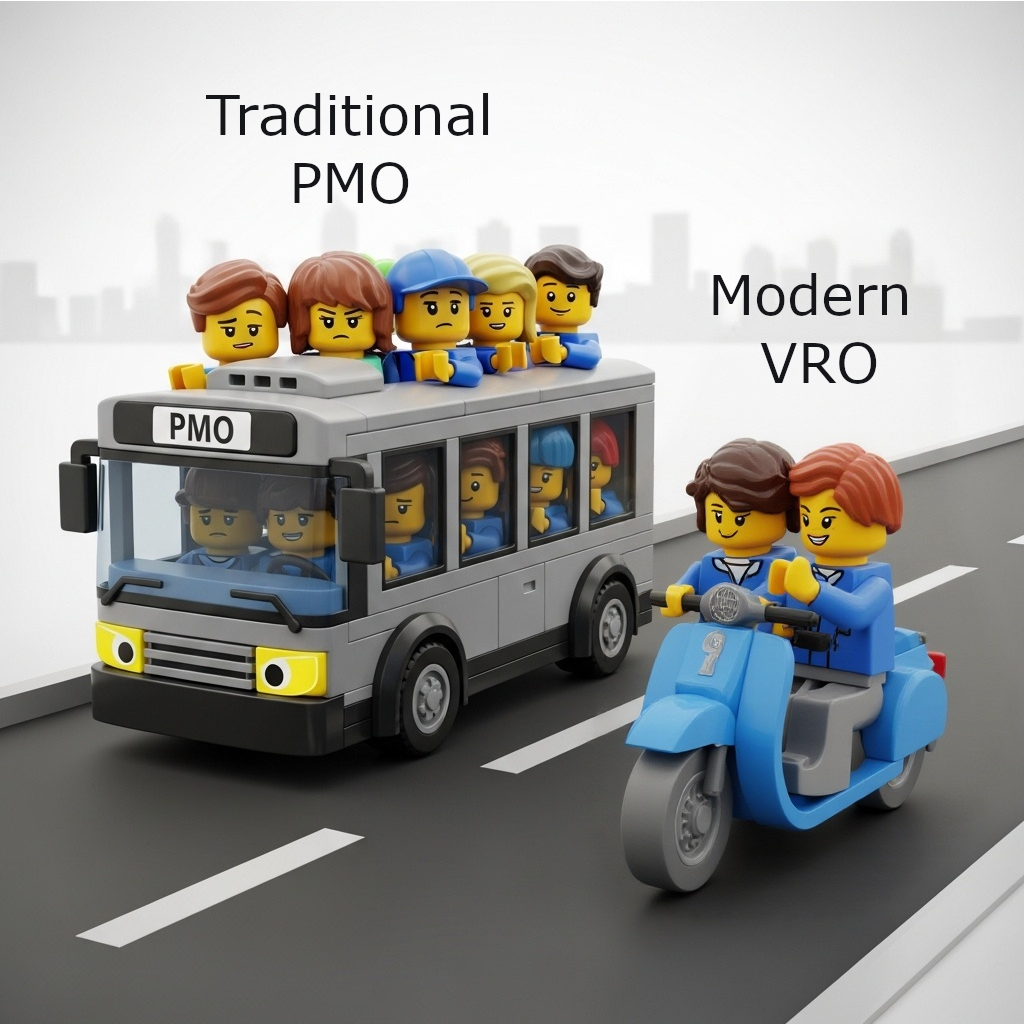
The Challenge: A major federal agency is 10 years into a multi-billion-dollar modernization program with 500 people delivering the solution — and 250 people in the Project Management Office (PMO) overseeing it. This extreme 1:2 oversight-to-delivery ratio has consistently slowed decisions, increased costs, and limited measurable results, reflecting a government-wide pattern that strangles mission delivery.
The Solution: Shrink PMOs to accelerate delivery. The counterintuitive approach: embed oversight and compliance functions directly within delivery teams while maintaining independence and accountability. This fundamental shift changes both mindset and behavior—when former oversight staff experience the friction their own processes create, they naturally eliminate bureaucracy that doesn't add delivery value.
Agencies implementing this Modern VRO™ transformation achieve sometimes massive productivity improvements, reduce PMO headcount by 25–40%, and dramatically improve on-time delivery.
💡Note on Scope
We use software-centric transformation examples, but the principles apply to most federal PMOs.
Improving Delivery Within Existing Budgets
Budget constraints don't necessarily mean slower delivery; the key is redirecting effort from oversight to execution.
Congress wants more results, OMB wants smaller budgets, and everyone wants faster delivery. Meanwhile, you're dealing with the same oversight requirements, the same compliance burden, and often the same staff you had years ago.
So what do we do? How can we really do more with less? There's one number that's an important indicator most programs overlook: how many people are overseeing work versus how many are actually doing it. This ratio tells you a lot about how fast your program can move and how much it will actually deliver. We call it the non-delivery to delivery staff ratio.
Most program managers we talk to know their total headcount, their burn rate, their milestone dates. But ask them how many people are in meetings about the work versus how many are building the actual solution? They have to stop and think. We get it — nobody tracks that ratio because they don't know how important it is.
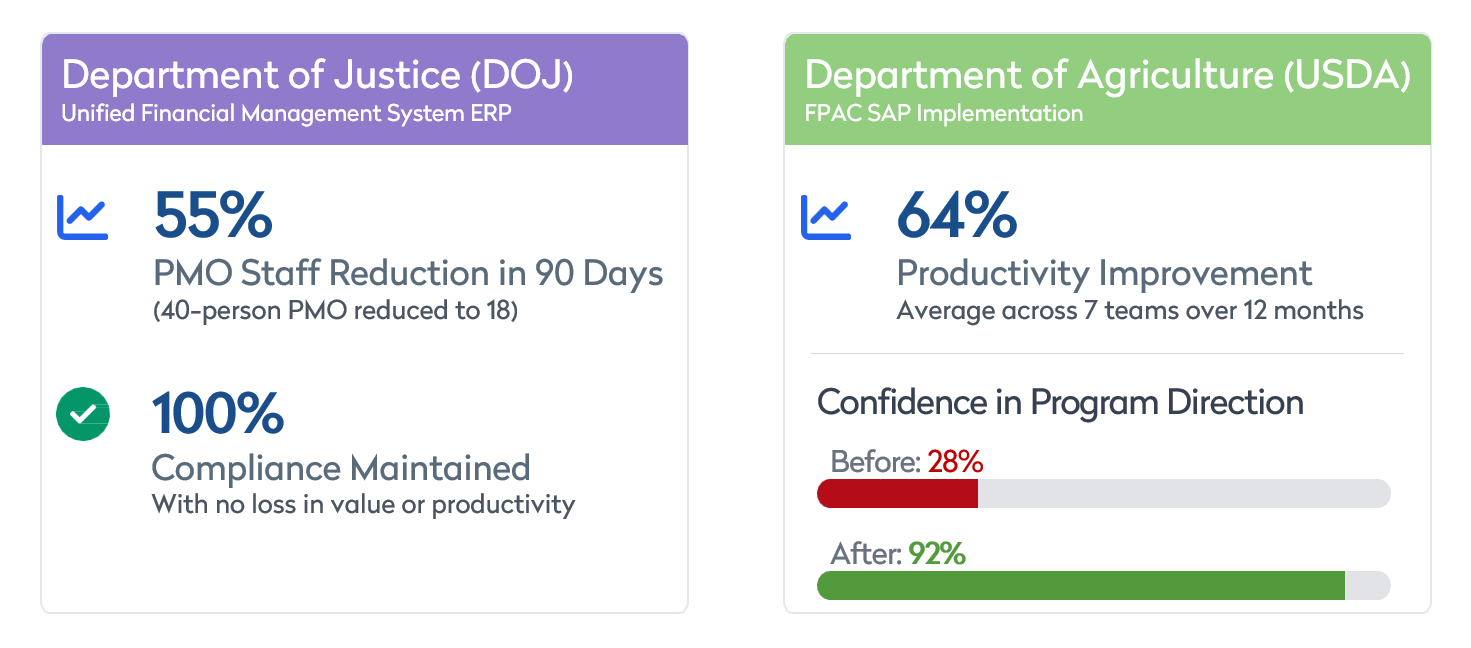
When agencies fix this ratio, they see significant results: up to 64% more productivity with significantly less overhead — with the same or fewer people and the same or lower budget. These metrics are based on documented outcomes from federal transformation programs completed 2009-2024. The change: stop having so many people in non-delivery roles and integrate them into delivery teams instead.
Note: Your current PMO staff is a reasonable proxy of non-delivery to delivery staff to start with, but it isn't exact. Our free calculator is being updated. We can do a short engagement under the micro-purchase threshold to help you get an accurate picture of your ratio, or you can use the manual steps below.
Many federal programs run 1:2 to 1:4 non-delivery to delivery staff ratios. That means for every two people building something, there's one person performing compliance or making rules for them to follow. Meanwhile, tech companies ship products every week. They run 1:10 ratios or better. One oversight person for every ten people actually building products.
When your non-delivery to delivery staff ratio is out of balance, everything becomes more expensive, more complex, and slower.
The result? Everyone means well. But that doesn't change that we're burning through billions in taxpayer dollars on bureaucratic overhead while the mission-critical work gets fewer resources. I've seen agencies spend more on oversight meetings than on the solutions they're supposedly overseeing. It's not just wasteful—it's mission negligence.
The Strategic Challenge
Based on our experience, bloated oversight ratios consistently create three critical risks: outright failures, delays, and self-reported (and avoidable) waste.
Large government software projects fail¹
(Source: 18F)
Average months of delays for major federal IT programs²
(Source: GAO)
Of time teams self-report wasted on process overhead³
(Source: Packaged Agile Surveys and Interviews)
Budget & Oversight Risk
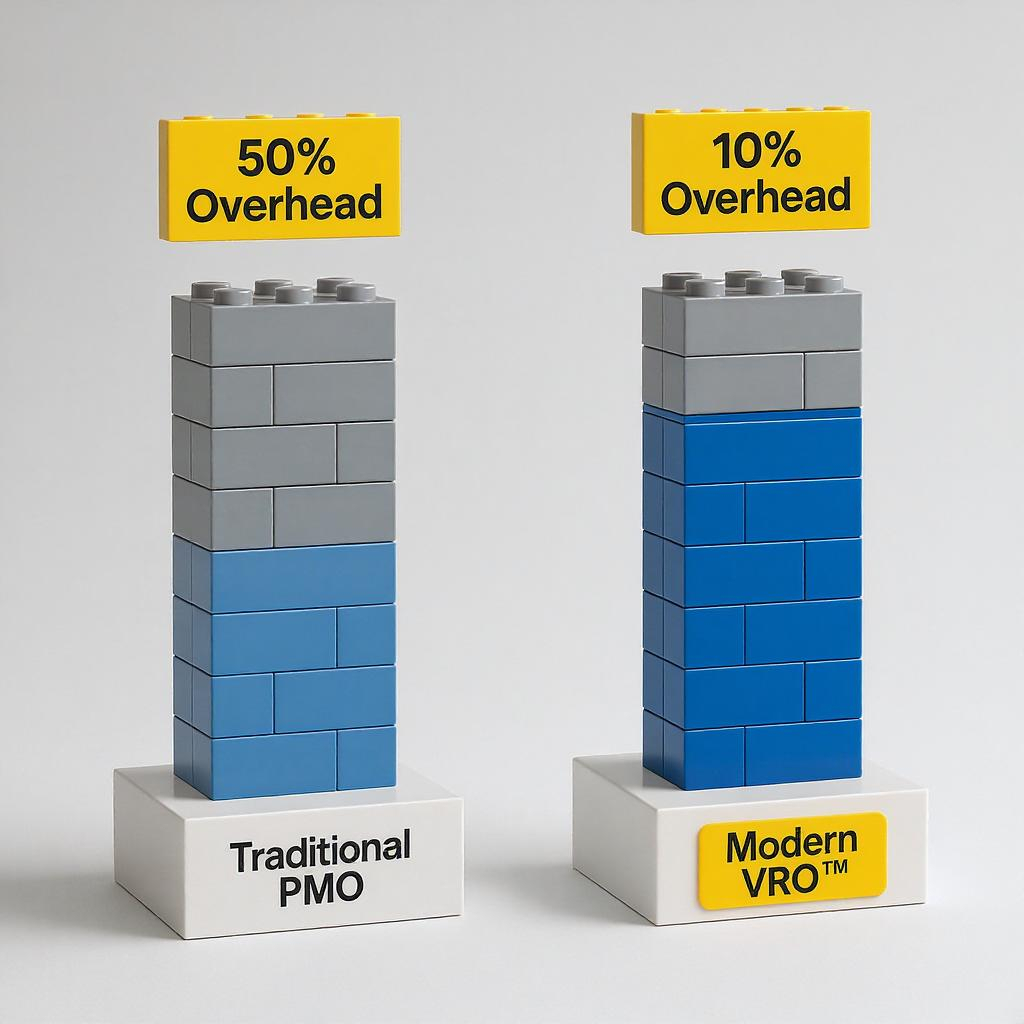
On a 100-person delivery team, bloated ratios mean 20–50 people working full-time on bureaucracy instead of mission outcomes. With DOGE scrutiny and budget cuts accelerating, this overhead draws audit findings and stakeholder criticism.
Security & Compliance Risk
Approval Lag: Oversized PMOs often increase security and compliance risks. More review layers create longer approval chains, delaying critical patches and updates. Leaner PMOs respond faster and have clearer accountability, improving both compliance and cyber-resilience.
The Mathematical Reality
Larger teams create exponential communication complexity⁴. A team of 10 has 45 possible communication paths, while a team of 50 has 1,225. When PMOs number in the hundreds, coordination overhead consumes more resources than actual delivery work.

The "Too Many People" Problem
When program teams exceed optimal size, staff inevitably create work to justify their presence — reinventing processes, adding unnecessary review cycles, and generating bureaucratic churn that actively impedes mission delivery. Unfortunately, we see this pattern playing out across federal programs every day. It's happening on some programs right now. While the topic differs, below is a common example.
💡Real Client Example
Twelve people spent five months reinventing a risk-management process already defined thousands of times before. The government lead wouldn't say "no" to the work because they wanted buy-in. We see scenarios like this frequently at federal agencies—leaders rarely realize how often oversized teams create work to justify their existence, often reinventing processes that already exist.
The Real Cost of Complexity
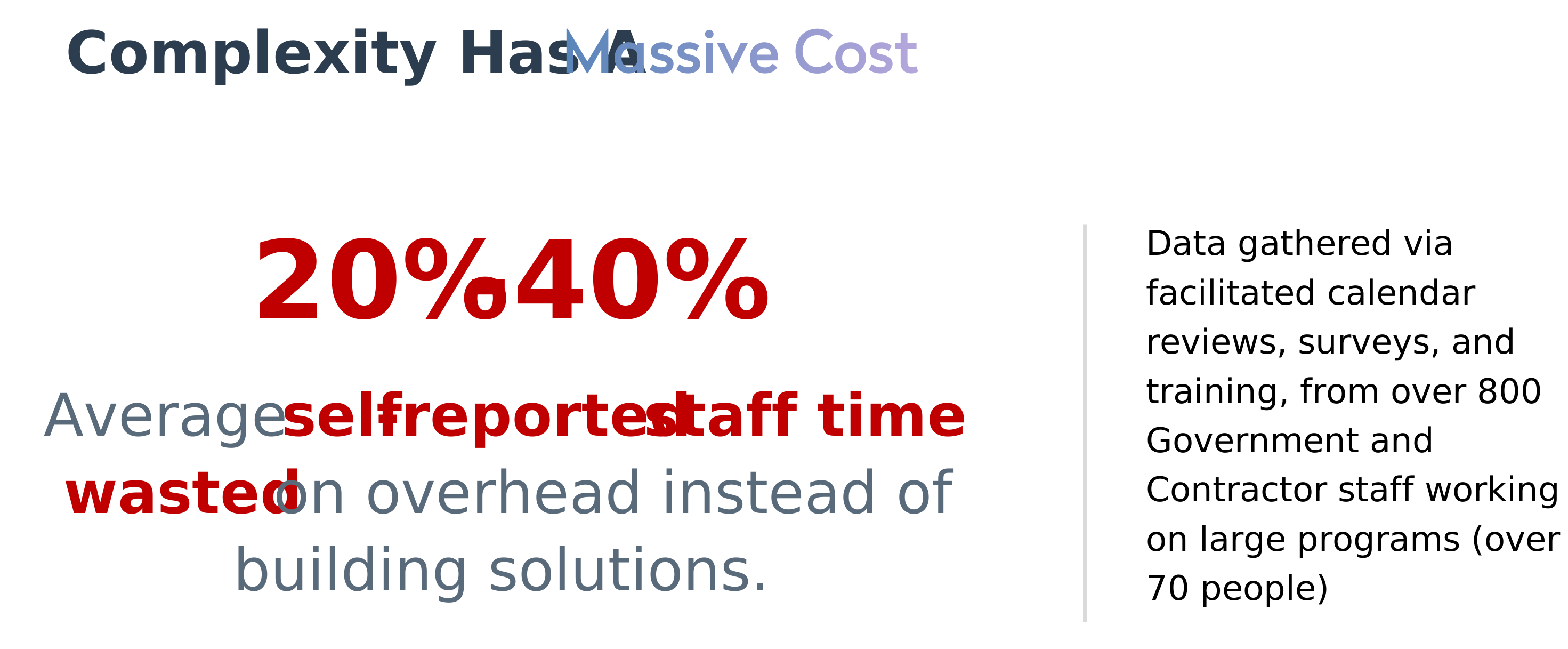
Hidden Waste: Through hundreds of interviews with government and contractor staff, comprehensive surveys, and joint calendar reviews, we documented the measurable impact of oversized PMOs. The data across large programs is shows:
The Ripple Effects of Oversized PMOs
Oversized PMOs don't just waste time—they create cascading issues that reduce organizational effectiveness:
- Accountability fog & decision paralysis: Too many layers create confusion about who's responsible and slow critical decisions to a crawl
- Misaligned contributors adding chaos: Under-skilled staff assigned to "help" often create more problems than they solve
- Team morale collapse: Endless redundant reviews and make-work assignments drain the energy and ownership that drives real results
These compounding effects don't just inflate costs and delay timelines — they fundamentally undermine an organization's ability to deliver meaningful value to the people it serves.
The Solution: Modern VRO™ Transformation
The path forward isn't eliminating oversight — it's embedding PMO functions within delivery teams to achieve 1:8 to 1:10 ratios while maintaining full compliance. It surfaces hidden work, makes it transparent, and empowers people to challenge waste.
The Modern VRO™ Model
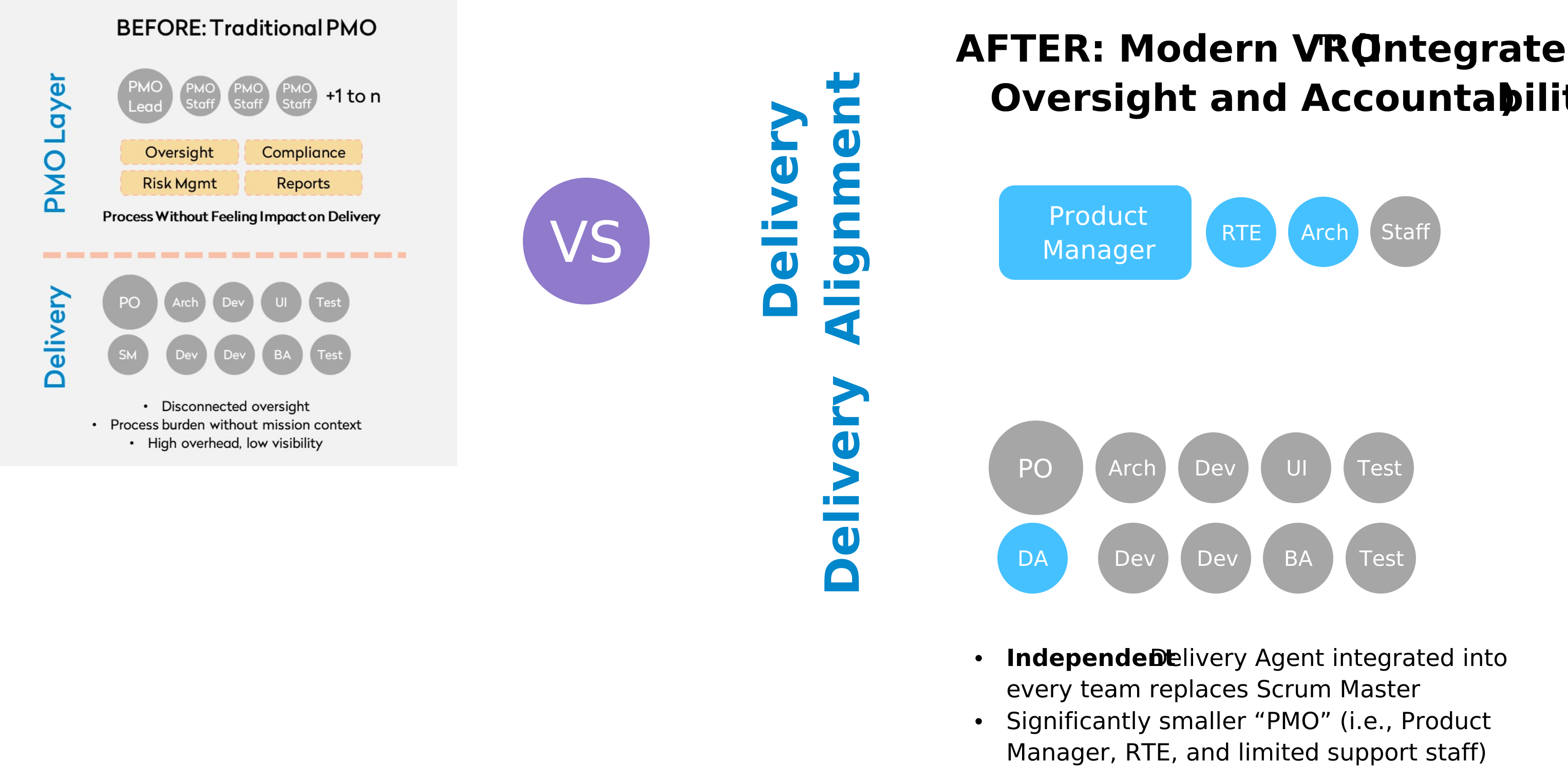
Modern VRO™ embeds oversight staff within the delivery organization, eliminating the distinction between PMO and delivery staff. Key PMO functions (like architecture, planning, and risk management) become part of unified delivery teams, while compliance and oversight personnel work embedded within the same organization—all focused on enhancing delivery as the primary goal. That turns out to be a critical accelerator.
For clients using SAFe® (Scaled Agile Framework) or Scrum@Scale®, this approach aligns naturally with their frameworks, which don't have separate PMOs but still maintain embedded oversight and compliance functions. But you don't have to use a framework. We've identified a set of "minimum viable bureaucracy" structures and activities that work as well or better.
Delivery-Focused Transformation
Note: A detailed implementation plan is beyond the scope of this document. If you're interested in discussing implementation specifics for your program, contact us.
A practical transformation usually includes the following high-leverage tactics that are often overlooked. Specific percentages and ratios are context-specific and tailored to each organization's unique situation. These proven methods reflect successful applications used to improve delivery and optimize PMO effectiveness.
Strategic Role Conversion (10-50% of non-delivery roles)
What We Do: Move oversight staff from separate PMO functions into embedded delivery team roles where they share accountability for actual delivery outcomes.
If your office already runs lean, the focus shifts to sharpening existing roles rather than large-scale conversion.
Why It's Critical & Overlooked: People in separate oversight roles have zero skin in the game. They can create processes, demand reports, and slow decisions without ever feeling the consequences. When embedded in delivery teams, they suddenly experience the friction their own bureaucracy creates. PMO staff who've never felt the pain of waiting 3 weeks for architectural approval become the strongest advocates for streamlining that process once they're on delivery teams waiting for their own approvals.
Measurable Impact: This single change can eliminate 15-30% of the documented waste we see, because embedded staff naturally eliminate bureaucracy that doesn't add delivery value. On a 100-person program, that's reclaiming 15-30 people worth of productive capacity.
Pure oversight roles devote >80% of their time to reporting, compliance reviews, and coordination—not direct delivery or coaching.
Delivery Agent: Strategic Alignment and Value Validation
What We Do: Embed a role specifically focused on continuously validating that team work connects to measurable strategic outcomes, not just completed tasks.
Why It's Critical & Overlooked: Most federal teams stay busy completing features, requirements, and tasks without anyone validating if that work actually drives mission outcomes. Delivery Agents surface when teams are building the wrong things efficiently. Programs gradually drift from strategic intent as teams focus on immediate deliverables. No one has explicit accountability for maintaining strategic alignment day-to-day.
Measurable Impact: Can eliminate 30-50% of work that doesn't drive strategic value. On large programs, this means redirecting millions of dollars from low-value activities to mission-critical outcomes.
Framework and Communication Optimization
What We Do: Start with the absolute minimum meetings required by your framework (SAFe®, Scrum@Scale®, etc.) and only add meetings that demonstrably improve delivery outcomes.
Why It's Critical & Overlooked: Organizations add meetings reactively to solve problems, but never remove them when the problems are solved. Most PMOs have 3-5x more recurring meetings than necessary. Leaders think more coordination meetings mean better oversight, but they actually create decision delays and diffusion of accountability.
Measurable Impact: Can reclaim 25-40% of staff time currently lost to unnecessary coordination. On our client programs, this typically means 2-3 extra productive days per person per week. Leaner ceremonies free 4-6 hours per person each sprint for high-value work.
Tactical Swarming Approach
What We Do: Concentrate intense, cross-functional collaboration on specific delivery challenges for short periods, then scale back as teams build capability.
Why It's Critical & Overlooked: Most organizations create permanent working groups for temporary problems. Swarming solves problems fast, then dissolves. Intensive collaboration rapidly builds institutional knowledge across teams, reducing dependency on subject matter experts.
Measurable Impact: Can compress 6-month problem-solving cycles into 2-4 weeks. Eliminates 60-80% of the escalation and coordination overhead that typically exists around complex delivery issues.
AI-Enhanced Delivery Analytics
What We Do: Use a lightweight AI dashboard (deployed on two DHS programs) that flags abandoned tasks, duplicated efforts, and cross-team bottlenecks in real time.
Why It's Critical & Overlooked: Human oversight only catches obvious inefficiencies. AI surfaces patterns of waste that are individually small but collectively massive. Traditional PMO reporting is backward-looking. AI analytics provide real-time course correction before waste compounds.
Measurable Impact: Typically identifies 15-25% productivity gains hidden in workflow inefficiencies. Can prevent resource waste before it happens rather than documenting it after the fact.
Measurable Results: Lean PMOs typically operate at a 1:8–1:10 oversight-to-delivery ratio, cutting bureaucracy without sacrificing governance. This shift significantly reduces bureaucratic overhead, improves decision-making speed, and enhances overall mission delivery, all while involving only moderate reductions in total PMO headcount.
Real Results from Government Agencies
Federal agencies implementing Modern VRO™ transformation have achieved remarkable improvements in both efficiency and mission delivery. These aren't theoretical projections — they're documented outcomes from federal agencies that implemented Modern VRO™ transformation. The results speak for themselves:
The Ratio Transformation Process
The Reality: This Transformation Is Achievable—Even on Large Programs
Fixing oversized PMO ratios isn't overly complex. Significant improvements can be achieved within 90 days, even on very large federal programs. However, success requires a disciplined approach and—critically—independent expertise.
Why Independence Is Essential
Without independent support, PMO transformation simply won't work. Internal staff face insurmountable conflicts: they must evaluate colleagues they work with daily, challenge leadership decisions they helped implement, and recommend changes that could affect their own career prospects. Independence eliminates these barriers and provides the objective analysis required for meaningful change.
The Procurement Advantage
Independent PMO transformation support is not terribly expensive. Most programs can achieve significant benefits for under the $250,000 Simplified Acquisition Threshold (SAT), enabling direct awards that are both quick and straightforward—perfect for agencies needing rapid improvements under budget pressure.
The following three steps help get started.
Step 1: Calculate Your Current Non-Delivery to Delivery Ratio
Quick Calculator: Don't know your ratio? Use this simplified assessment to get started.
Count Your Hands-on Delivery Staff:
- Software developers, system integrators, data analysts
- UX/UI designers, architects, engineers
- Product owners, anyone building, configuring, or testing solutions
- Your Delivery Team Count: _____
Count Your Non-Delivery Staff:
- Schedule analysts, risk management analysts, EVM analysts
- Compliance analysts, process managers, governance staff
- Project managers, program coordinators, anyone primarily focused on oversight, reporting, or coordination
- Your Non-Delivery Staff Count: _____
Calculate Your Ratio:
- Non-Delivery Staff ÷ Delivery Team = Your Ratio
- Example: 25 non-delivery staff ÷ 50 delivery staff = 1:2 ratio
What Your Ratio Means:
- 1:10 or better = Excellent (proven results)
- 1:8 to 1:9 = Fair (solid performance)
- 1:6 to 1:7 = Concerning (improvement needed)
- 1:5 or worse = Major impediment to fast, high-quality delivery
Note: This is a simplified assessment. Our full diagnostic takes under 10 days even for large programs and includes stakeholder interviews, artifact sampling, detailed role mapping, hybrid function analysis, vendor staff categorization, and a rapid-insights workshop for precise optimization.
The Independent Expert Imperative
Critical Reality: This transformation is near impossible to execute effectively without independent experts leading the analysis. Existing program staff have too much vested interest and are too worried about upsetting colleagues to make the tough decisions required.
Why Internal Staff Can't Lead This:
- Personal Relationships: They work daily with people whose roles may need to change
- Career Concerns: Challenging the status quo could impact their own advancement
- Institutional Blindness: They're too close to see inefficiencies that outsiders spot immediately
- Risk Aversion: They fear pushback from leadership who originally designed the current structure
Independent experts provide the objective clarity internal staff often cannot provide, along with proven methodologies and the ability to have difficult conversations without personal consequences. They can challenge sacred cows, question long-held assumptions, and recommend changes that internal staff would never suggest.
Step 2: Establish Your Baseline
Start with the 1:15 Foundation
- Establish floor: a good start for the floor is 1 non-delivery person for every 15 delivery staff
- This becomes your baseline—the absolute minimum oversight structure
Question Every Addition Beyond Baseline
- Distinguish compliance from bureaucracy - What's legally required (e.g., FAR compliance reporting,
FISMA security reviews, OMB A-11 capital planning) vs. organizational habit? - Challenge every PMO-related requirement - Ask "Does this help teams deliver or just
create overhead?"
Step 3: Test and Optimize
The Lean Testing Approach
- Test by elimination - In areas with relatively low risk, try moving forward without certain positions to see what actually happens
- Be prepared to add people back if genuinely needed, but be very careful about adding until it's proven necessary
- Only add back roles when you have concrete evidence that the work cannot be absorbed by existing delivery teams
Identify Automation Opportunities
- Administrative task automation - What routine reporting, status updates, or coordination tasks can be automated?
- Workflow optimization - Where can embedded delivery agents handle work that currently requires dedicated oversight staff?
- Tool consolidation - What manual processes can be streamlined through better tooling or integration?
Leverage Embedded Delivery Capacity
- Remember: embedded delivery agent staff on each team can handle the majority of administrative requirements
- Focus on what delivery teams can absorb rather than what oversight teams must retain
[GRAPHIC PLACEHOLDER: Lean testing flowchart showing baseline establishment, elimination testing, and evidence-based role addition process]
Why This Matters Now
The Federal Efficiency Imperative
With DOGE oversight, budget cuts, and federal retirements accelerating across government, agencies must get leaner fast. Oversized PMOs are exactly where there's fat to trim — and where cuts actually improve delivery outcomes.
[GRAPHIC PLACEHOLDER: Infographic showing DOGE pressure, budget constraints, and workforce changes driving the need for PMO transformation]
The Competitive Advantage
Agencies that embrace Modern VRO™ approaches gain significant advantages:
- Faster response to changing mission requirements
- Better talent retention through reduced bureaucracy
- Improved stakeholder confidence through visible results
- Enhanced reputation for efficient, effective delivery
Conclusion: From Oversight to Outcomes
Right-sizing a PMO is less about cutting positions and more about amplifying mission impact. The 1:2 PMO ratio is a relic of an era when more oversight seemed like better governance. Today's federal environment demands efficiency, speed, and results — not bureaucratic theater.
Modern VRO™ transformation offers a proven path to:
- 1:8 to 1:10 sustainable ratios that balance compliance with delivery effectiveness
- 55% cost reductions with measurably better mission outcomes
- Dramatically improved team morale and stakeholder satisfaction
In today's federal environment, your PMO must transform. The question is whether you'll lead proactively or reactively, moving from bureaucratic control to delivery enablement.
References
• According to 18F's Federal Field Guide, only 13% of large government software projects are successful.
• GAO reports indicate that many federal IT modernization efforts experience significant schedule delays, often exceeding 18 months.
• Self-reported waste based on calendar analyses and feedback from hundreds of Government and contractor staff on large-scale federal programs.
• The "communication channels" formula and the importance of small teams for effective coordination are discussed in Fred Brooks' "The Mythical Man-Month" and supported by modern research. See also Harvard Business Review.