

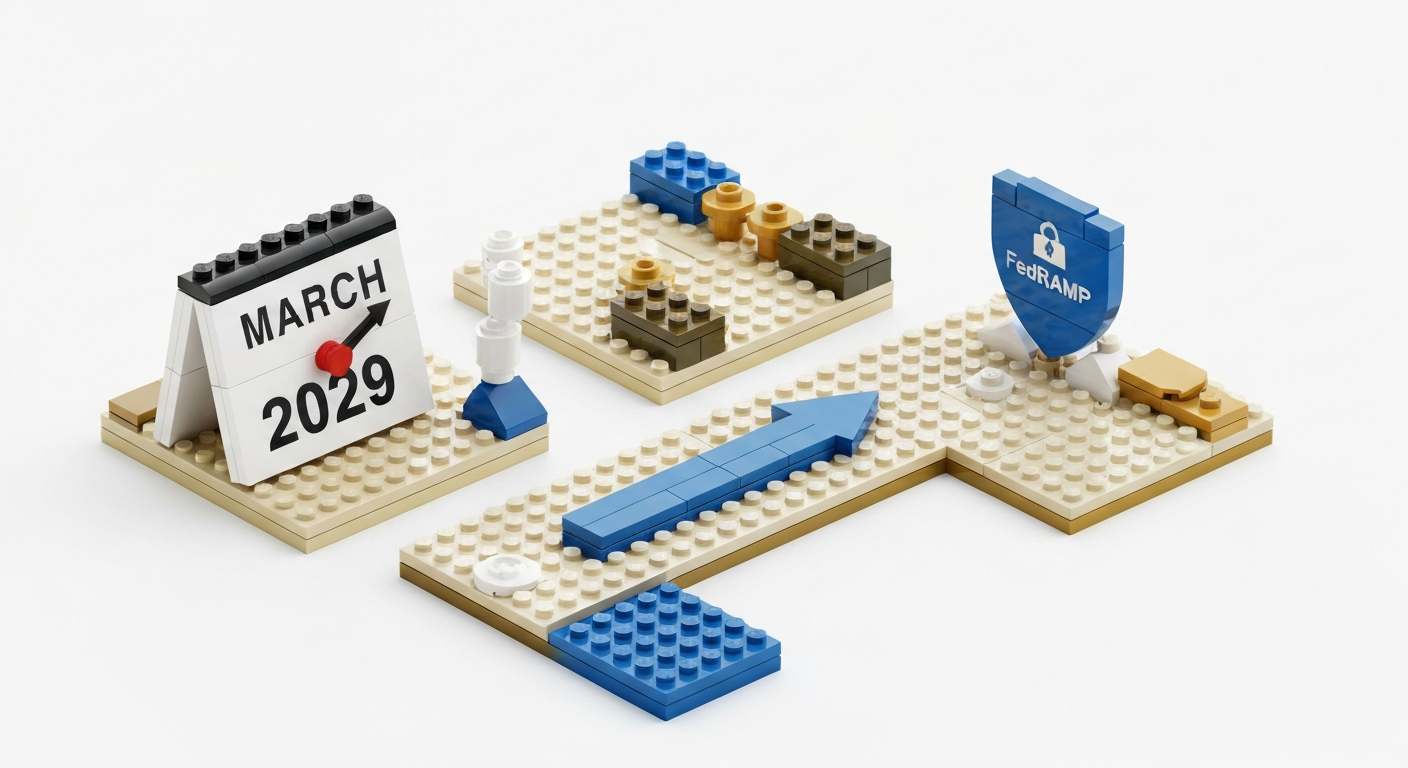
💡Bottom Line Up Front
Atlassian is ending all Data Center products by March 28, 2029. Every U.S. cabinet agency uses Atlassian tools, and most federal environments have years of custom scripts, workflows, and integrations that won't translate cleanly to Cloud. If your agency requires FedRAMP High, IL5, or operates air-gapped networks, no Atlassian Cloud path exists today. Migration planning needs to start now—not in 2028.
What Happened
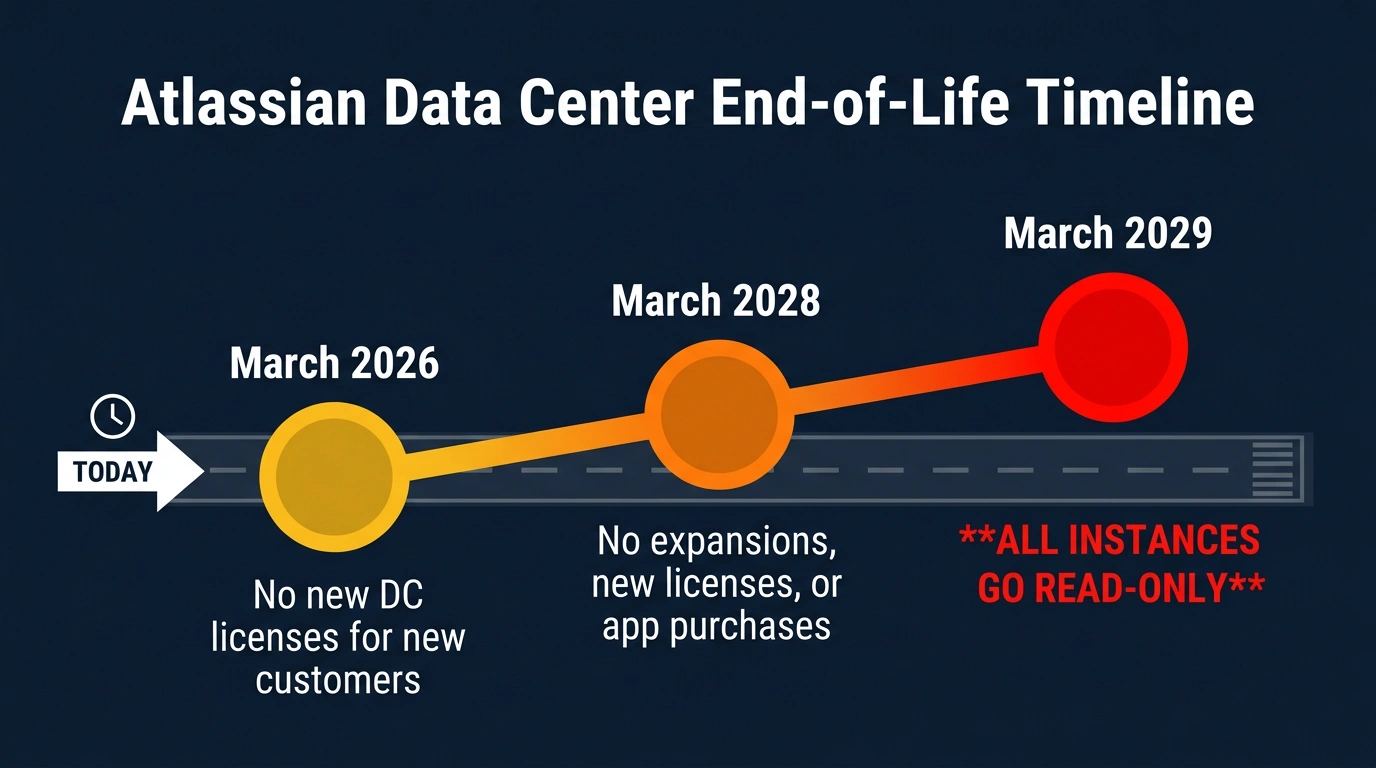
On September 8, 2025, Atlassian announced the end-of-life for all Data Center (DC) products, effective March 28, 2029. On that date, every Jira, Confluence, and Jira Service Management (JSM) Data Center instance goes read-only.
According to Atlassian, every U.S. cabinet agency currently uses Atlassian tools. For those agencies and the hundreds of contractors supporting them, this is a forced migration with operational, compliance, and technical consequences.
The deadlines start hitting well before 2029:
This affects hundreds of federal agencies, defense organizations, and government contractors running mission-critical workflows on Atlassian Data Center. The true level of effort involved is far greater than Atlassian's messaging suggests.
Compliance Gaps
Atlassian Government Cloud achieved FedRAMP Moderate authorization in March 2025, sponsored by GSA. That's a meaningful step forward, but if your agency falls under DoD, the Intelligence Community, or handles national security data, FedRAMP Moderate isn't sufficient. You need FedRAMP High or DoD Impact Level 5 (IL5) authorization.
Atlassian has stated it is "working on building the FedRAMP High and Impact Level 5 environments to submit for authorization prior to the end of life for Data Center products." There is no published timeline and FedRAMP High authorization typically takes 18 to 24 months after Moderate is awarded. That puts the earliest realistic availability sometime in late 2027 at best.
Three other gaps worth your attention:
- Jira Align has no FedRAMP path. It's excluded from both the DC end-of-life timeline and Government Cloud. If your agency uses Jira Align for SAFe portfolio management, there's no compliant cloud option within the Atlassian ecosystem right now. This means that agencies relying on Jira Align for SAFe planning need to treat this as a separate tooling decision. The practical move is to begin evaluating stand-alone agile planning platforms that support on-premises or air-gapped deployment and offer native SAFe capabilities at the portfolio level. Waiting for Atlassian to announce a path forward is not a viable compliance strategy.
- Government Cloud has a limited app ecosystem. About 60 Marketplace apps are available on Government Cloud compared to over 4,000 on the commercial Atlassian Marketplace.[1][2] Apps must be rebuilt as Forge apps and go through additional security approval.[3] Many plugins your teams depend on may not be available.
- Air-gapped environments have no Atlassian Cloud option. Atlassian's Isolated Cloud (expected 2026) is internet-connected and Atlassian-managed.[4] It does not address SCIF or classified network requirements.
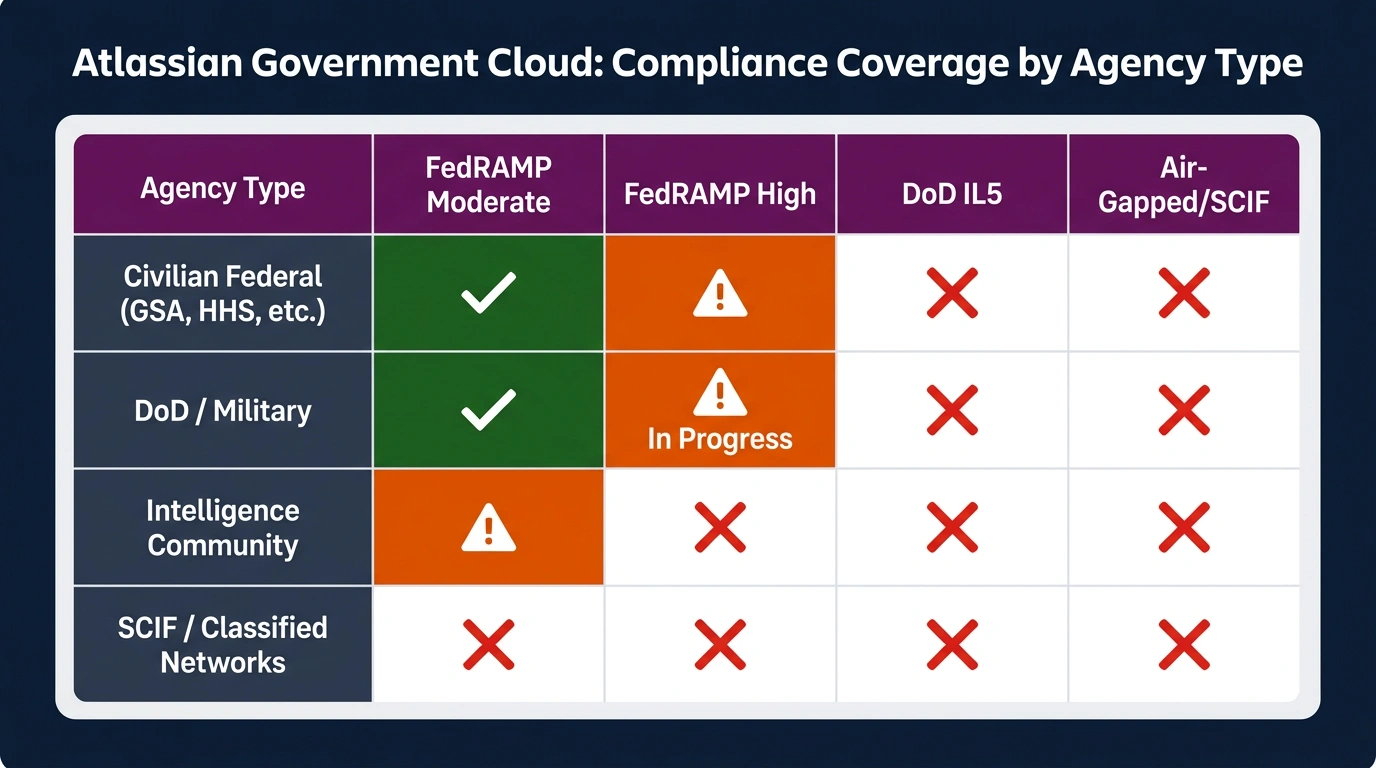
| 1 | FedRAMP High or IL5?No Atlassian Cloud path exists today. |
| 2 | Jira Align for portfolio management?Not included in Government Cloud. |
| 3 | Air-gapped or classified networks?No Atlassian Cloud option. |
| 4 | Depend on Marketplace plugins outside the top 60?Confirm availability before assuming continuity. |
⚠️Quick Compliance Check
If any of these four conditions apply to your agency, your migration planning needs to start now. There is no Atlassian Cloud workaround for these scenarios today.
Why Migration Takes Longer Than You'd Expect
Data Center gives technical teams complete control, direct database access, custom scripting, and deep integrations, but requires dedicated IT resources to manage infrastructure, security patches, and backups. Cloud trades some customization depth (you're limited to Atlassian's APIs rather than code-level access) but offloads operational overhead with automatic updates, built-in compliance controls, and predictable costs. The March 2029 deadline forces agencies to decide whether their customization needs justify the infrastructure investment, or whether Cloud's managed model better fits their modernization priorities.
If your instance is mostly out-of-the-box, migration is manageable. But most federal environments aren't that simple. Here's where the effort concentrates:
- ScriptRunner scripts can't auto-migrate. The Cloud version replaces Groovy with JavaScript/TypeScript and Jira expressions. It has a 240-second execution timeout, loses roughly half of JQL functions, and eliminates user impersonation. Most scripts need to be rewritten from scratch.
- Custom workflows and fields often don't translate. Workflows, permission schemes, and custom fields that evolved over the years in DC don't map directly to Cloud's standardized templates. Plan for significant redesign work.
- Integrations need to be rebuilt. Anything built on the Java API or direct database connections must be rearchitected for REST APIs with rate limiting, pagination, and token-based authentication.
- Atlassian's migration tool has constraints. The Jira Cloud Migration Assistant (JCMA) requires downtime, doesn't support data transformations, and depends on per-app migration support.[5] Large environments face API throttling and partial transfer failures.
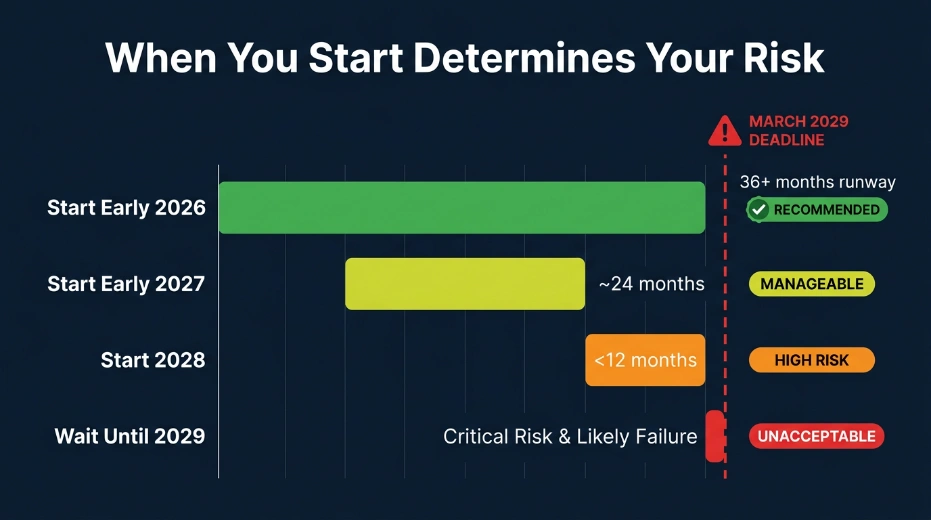
Atlassian's solution partners consistently estimate 12 to 24 months for complex enterprise migrations. To put that in perspective, if your agency starts planning in early 2027, you're already looking at a migration that runs right up against the March 2029 deadline, with little margin for procurement delays, staffing gaps, and the routine ATO reviews in federal IT.
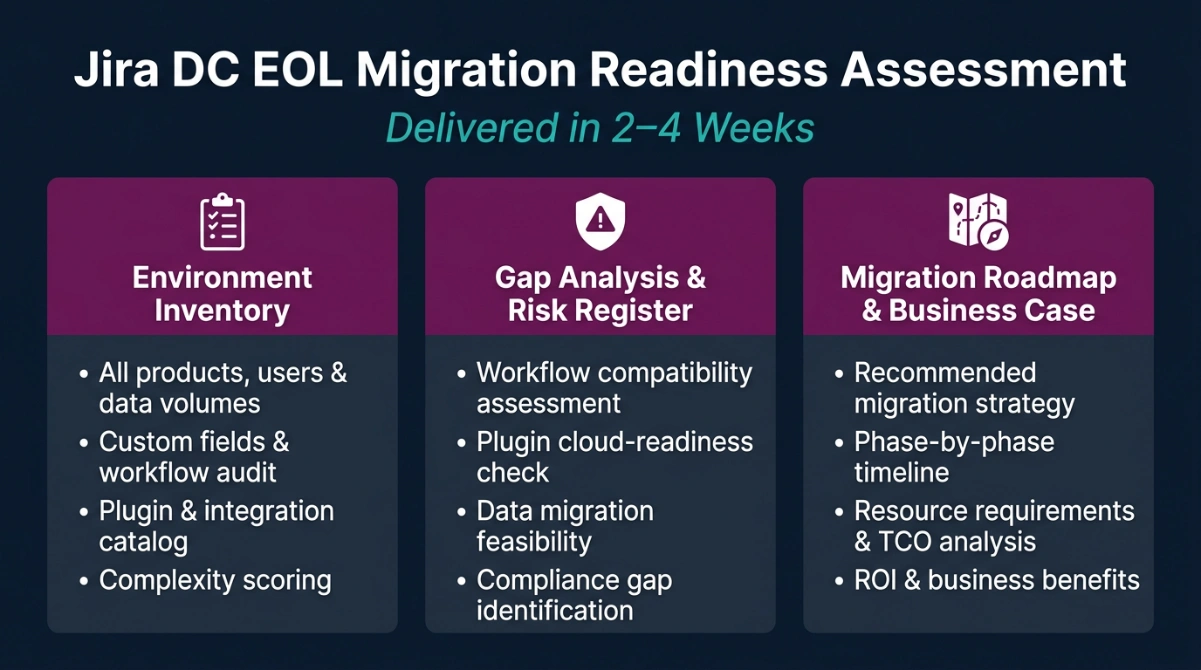
We built a fixed-scope engagement specifically for federal agencies working through this transition. In 2 to 4 weeks, we deliver a clear picture of where you stand, what migration will cost, and which path fits your compliance and mission requirements.
What This Means for Your Agency
This is not a simple product upgrade; this is a decision that touches procurement, security, compliance, and day-to-day operations simultaneously. For most federal agencies, it will be one of the largest IT modernization efforts in FY2027 and FY2028.
- You need to budget for this now. Migration requires funding for assessment, execution, dual licensing during the transition period, Cloud subscriptions, and training. If you're targeting execution in FY2028, procurement planning needs to start in FY2027.
- Your ATO will need to be updated. Agencies with existing Authorities to Operate for DC environments will need new or updated ATOs for any replacement platform, whether that's Atlassian Cloud or an alternative. In practice, that means updating your System Security Plan (SSP), conducting a new security assessment, remapping controls to the new architecture, and routing the package through your authorizing official. For most agencies, that process takes four to eight months, even when the new platform already has provisional authorization. If you're migrating to a platform that does not yet have FedRAMP High or IL5, add the vendor's authorization timeline on top of yours.
- Your teams will feel this. Different interfaces, changed workflows, lost automation. Change management and retraining aren't optional line items. They're central to whether this migration succeeds.
- This is the right time to evaluate alternatives. You are not required to migrate to Atlassian Cloud. On-premises agile platforms exist that support FedRAMP High environments, air-gapped deployment, and portfolio-level planning. Digital.ai Agility, for example, offers on-premises deployment with FedRAMP authorization and native SAFe support from team through portfolio level. Other vendors in this space are also investing in federal-ready capabilities. The right answer depends on your compliance posture, customization depth, and mission needs, but the point is that Atlassian Cloud is not the only path, and for some agencies it is not a viable path at all.
Atlassian has indicated they may offer extended maintenance after March 2029 for agencies with special circumstances. Pricing hasn't been announced but is expected to be significantly higher. That's a bridge while you execute a migration. It's not a strategy on its own.
Where to Start
The agencies that begin assessment now will have two-plus years of runway to move methodically. The ones that start in 2028 will be making decisions under pressure, paying premium rates for migration support, and accepting more risk. Meanwhile, costs are already rising. Atlassian announced a roughly 15% price increase on Data Center products effective February 2026, even as the product line is being sunset. That means agencies are paying more for a product with a fixed expiration date. Each renewal cycle without a migration plan in place increases your total cost of transition.
The first step is straightforward: get a clear picture of what you have. Inventory your Atlassian environment: products, users, custom fields, workflows, plugins, integrations, and data volume. Identify the customizations that will need redesign. Determine your compliance requirements. Bring in your PMO, IT security, and procurement teams early.
Without that baseline, you can't accurately scope migration timelines, estimate costs, or evaluate whether Atlassian Cloud, an alternative platform, or a phased hybrid approach is the right fit. Agencies that skip this step typically discover scope gaps mid-migration.
The choice between Atlassian Cloud, an alternative platform, or a hybrid approach depends on your agency's compliance posture, customization depth, and mission requirements. The one thing that isn't optional is starting the assessment now.
Schedule a Migration Readiness Assessment